
Some people have naturally fuller calves or less-defined ankles, even when they maintain a healthy weight and exercise regularly. This may be related to genetics, fat distribution, muscle development or the natural structure of the legs.
Leg liposuction is a body-contouring procedure that may help reduce localised fat deposits in the lower legs, particularly around the calves and ankles. The aim is to create a more balanced silhouette rather than simply make the legs smaller.
At Quartz Clinique in Istanbul, the suitability of the procedure is assessed according to individual anatomy, skin quality and treatment expectations.

What Is Leg Liposuction?
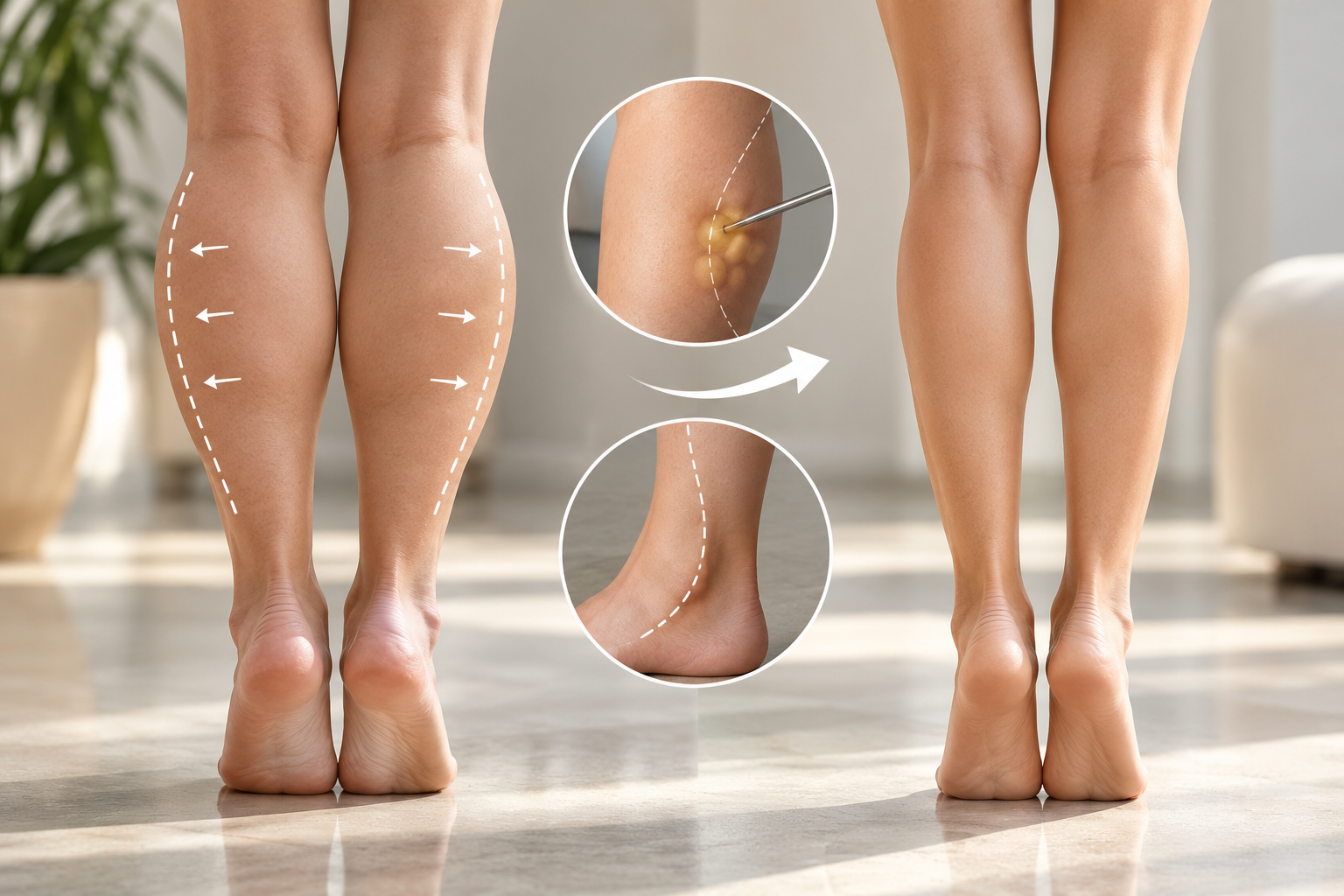
Leg liposuction involves removing selected deposits of subcutaneous fat through small incisions using a thin surgical cannula.
Unlike general weight-loss procedures, it targets specific areas that may remain fuller despite changes in body weight. However, the appearance of the lower legs is not determined by fat alone. Muscle size, bone structure and fluid retention can also affect their shape.
This distinction is especially important in calf and ankle contouring. Liposuction cannot reduce muscle volume or change the underlying skeletal structure.
Calf and Ankle Liposuction: Which Areas Can Be Treated?
The calves and ankles form a continuous contour, so both areas should be evaluated together before planning surgery.
Calf Liposuction
Calf liposuction may be considered when excess fat contributes to a bulky lower-leg appearance.
Some people naturally have prominent calf muscles rather than significant fat deposits. In these cases, removing fat may not produce the desired change.
The goal is to improve proportions while preserving the natural shape of the calf.
Ankle Liposuction
Ankle liposuction focuses on localised fatty tissue that makes the transition between the calf and ankle less defined.
This appearance is sometimes described as cankles. However, thicker ankles may also result from swelling, circulation problems or skeletal anatomy.
Before considering liposuction, it is important to identify the underlying cause.
How Is Leg Liposuction Performed?
The procedure begins with an examination of the lower legs to assess fat distribution, skin elasticity and anatomical structures.
Small incisions are made in carefully selected locations, and excess fat is removed using a cannula.
In suitable cases, VASER liposuction may be considered. This technique uses ultrasound energy to assist with fat removal. However, the choice of technique depends on the patient’s anatomy and the surgeon’s assessment.
Because the calves and ankles contain important nerves, blood vessels and other structures, lower-leg liposuction requires particularly careful planning.
Treatment Areas and Considerations
| Treatment Area | Main Concern | Important Consideration |
|---|---|---|
| Calves | Localised fat contributing to lower-leg fullness | Muscle size must be distinguished from excess fat. |
| Ankles | Reduced definition between the calves and ankles | Swelling and circulation problems should be assessed. |
| Inner Knees | Fat deposits affecting overall leg proportions | Treatment is planned according to the individual leg contour. |
Who Is a Suitable Candidate?
Leg liposuction may be suitable for adults with localised fat deposits, stable body weight and realistic expectations.
Good skin elasticity can support a smoother contour after fat removal, although individual results vary.
The procedure may not be appropriate when lower-leg fullness is mainly caused by muscle development, bone structure or medical conditions associated with swelling.
Patients with unexplained leg swelling or circulation problems should undergo appropriate medical evaluation before cosmetic surgery is considered.
Recovery After Leg Liposuction
Swelling, bruising and mild discomfort are common during the early recovery period. Because the calves and ankles are located in the lower part of the body, swelling may take time to resolve.
Compression garments may be recommended to support the treated tissues. Gentle walking is often encouraged when medically appropriate, while strenuous exercise should be postponed until the surgeon provides clearance.
Many patients gradually return to everyday activities within the first few weeks, depending on the extent of surgery and their individual recovery.
The final contour may take several months to become apparent as residual swelling decreases.
For international patients travelling to Istanbul, the timing of return flights should be discussed with the surgical team because prolonged immobility after surgery can increase the risk of blood clots.
Results and Possible Risks
Leg liposuction may create a more defined lower-leg contour when removable fat is responsible for unwanted fullness.
Fat cells removed during surgery are generally permanently removed, but remaining fat cells can still enlarge with weight gain. Maintaining a stable weight can help preserve the result.
As with any surgery, possible complications include infection, bleeding, contour irregularities, asymmetry, changes in sensation and prolonged swelling. More serious risks include blood clots and injury to nearby structures.
The amount of fat removed must be carefully planned to avoid excessive reduction or an unnatural appearance.
Leg Liposuction Cost in Turkey
The cost of leg liposuction in Turkey depends on the areas treated, the surgical technique, anaesthesia requirements and the individual treatment plan.
Calf and ankle contouring may require a more selective approach than liposuction of larger body areas.
At Quartz Clinique in Istanbul, the appropriate treatment options and individual costs can be discussed following an assessment.
Frequently Asked Questions
Can liposuction make my calves smaller?
Yes, in selected patients whose calf fullness is partly caused by removable subcutaneous fat. It cannot reduce enlarged muscles or change bone structure.
Can ankle liposuction treat cankles?
It may help when localised fat is the main cause. If the appearance is related to swelling or circulation problems, other medical evaluation or treatment may be needed.
How long does swelling last after leg liposuction?
Swelling generally improves over several weeks, although residual swelling can continue for months. Recovery varies between patients.
Does leg liposuction leave scars?
Small incisions are required, so minor scars are expected. Their visibility depends on incision placement and individual healing.
Are the results permanent?
Removed fat cells do not normally return, but weight changes, ageing and skin elasticity can influence the long-term appearance of the legs.
Leg Liposuction in Istanbul
For patients considering leg liposuction in Istanbul, the most important step is determining whether localised fat is actually responsible for the shape of the calves or ankles.
A personalised assessment helps establish whether surgery is appropriate, which areas may benefit from treatment and what results can realistically be expected.
This article provides general medical information and does not replace an individual surgical consultation.
Content Responsibility and Medical Review

Medical expert
Specialist in Plastic, Reconstructive and Aesthetic Surgery
Leyla Arvas graduated from Istanbul University, Istanbul Faculty of Medicine in 1998 and is a specialist in Plastic, Reconstructive and Aesthetic Surgery.
Dr. Leyla Arvas sees patients at her private practice and performs her surgeries at Acıbadem Hospital and Memorial Hospital, both of which are accredited by the Joint Commission International (JCI).
Medical content lead for Leg Liposuction: MD, Leyla Arvas, MD
Last updated: