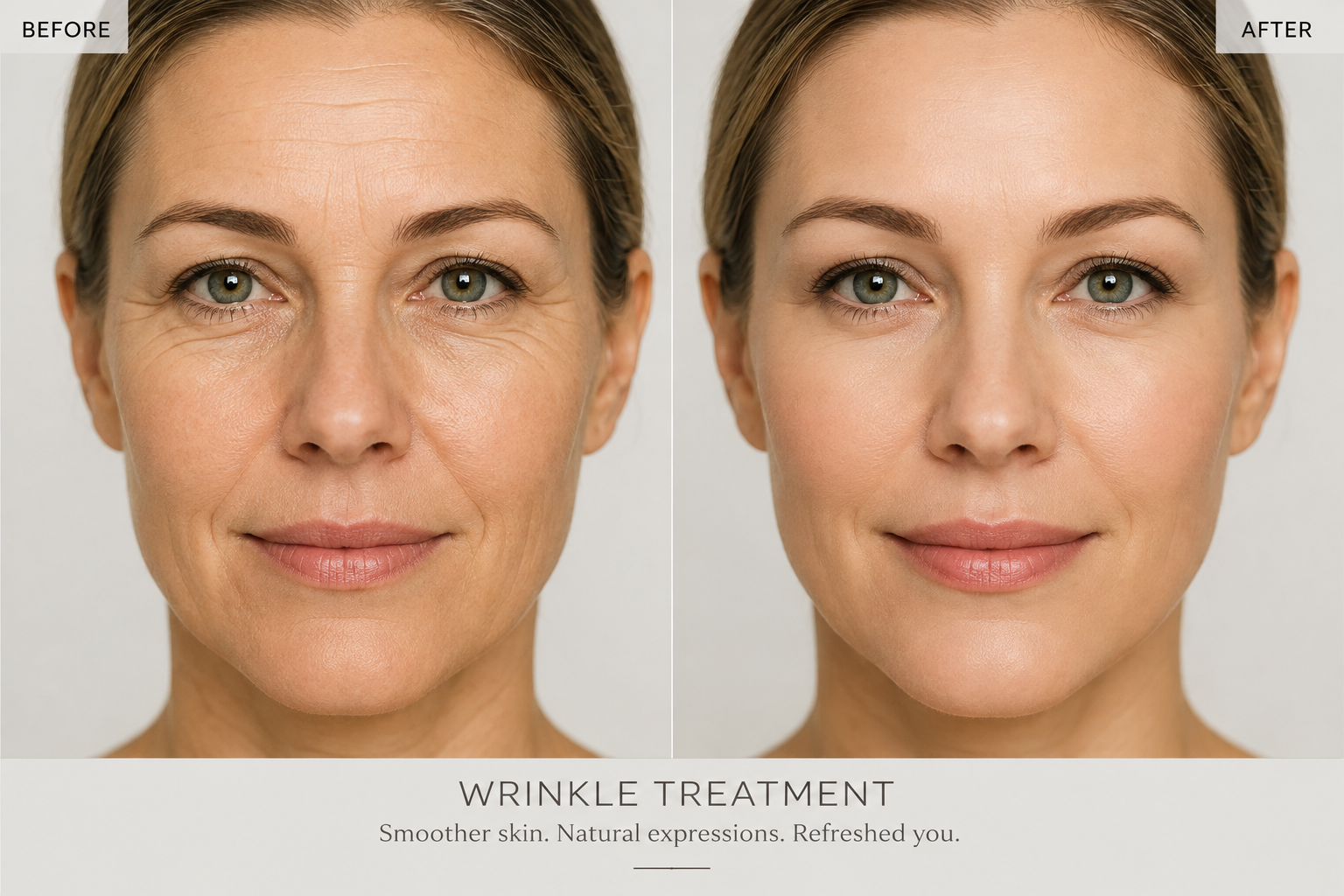
Wrinkles are a natural part of ageing, but not all wrinkles develop for the same reason. Some appear when we smile, frown or raise our eyebrows, while others become visible even when the face is at rest. Changes in collagen, skin quality, facial volume and skin laxity can all influence how lines develop over time.
This is why there is no single treatment that works for every type of wrinkle.
At Quartz Clinique in Istanbul, wrinkle treatment is planned according to the type and location of the lines, skin quality, facial movement, volume loss and the degree of skin laxity. Depending on these factors, treatment may involve anti-wrinkle injections, dermal fillers, skin boosters, collagen-stimulating treatments or technologies such as Morpheus8, Thermage FLX and Ultherapy.
What Causes Facial Wrinkles?
As we age, the skin gradually produces less collagen and elastin. It may become thinner, drier and less able to return to its original position after repeated facial movement.
Sun exposure also plays an important role. Over time, UV damage can affect collagen and contribute to fine lines, uneven texture and changes in skin elasticity.
Other factors can influence how early or how noticeably wrinkles appear, including:
- Genetics
- Repeated facial expressions
- Sun exposure
- Smoking
- Changes in facial volume
- Skin quality and hydration
- Weight fluctuations
- Natural changes in facial structure with age
Rather than looking at age alone, it is more useful to understand why a particular line has developed.
Different Types of Wrinkles
One of the most important distinctions is between dynamic and static wrinkles.
Dynamic Wrinkles
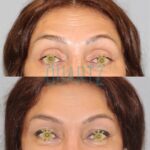
Dynamic wrinkles appear primarily during facial expression.
Common examples include:
- Forehead lines when raising the eyebrows
- Frown lines between the eyebrows
- Crow’s feet when smiling
Repeated muscle movement can make these lines more noticeable over time.
Anti-wrinkle injections are commonly considered when excessive muscle activity is the main reason for the lines.
Static Wrinkles
Static wrinkles remain visible when the face is relaxed.
They can develop as dynamic lines become more established, but ageing of the skin, collagen loss, sun damage and changes in facial volume can also contribute.
Deeper static wrinkles often need a different approach from expression lines.
Fine Lines and Crepey Skin
- Fine lines are often associated with changes in skin quality rather than a single overactive muscle.
- They may be particularly noticeable around the eyes, cheeks, mouth, neck and décolletage.
- Treatments designed to improve hydration, collagen production or skin texture may be more relevant in these cases.
Wrinkles Associated with Volume Loss
Not every line is actually caused by the skin itself.
Loss and redistribution of facial volume can change the support beneath the skin, making folds and shadows more noticeable. This is particularly relevant around the cheeks, mouth and lower face.
In these cases, simply treating the wrinkle directly may not provide the most natural-looking approach.
Wrinkle Treatments at a Glance
| Main Concern | Treatments That May Be Considered |
|---|---|
| Forehead and frown lines | Anti-wrinkle injections |
| Crow's feet | Anti-wrinkle injections |
| Deeper folds and volume loss | Dermal fillers |
| Fine lines and dehydrated skin | Skin boosters |
| Reduced collagen and skin quality | Collagen biostimulation |
| Fine lines and uneven texture | RF Microneedling / Morpheus8 |
| Skin laxity with wrinkles | Thermage FLX / Ultherapy |
| Multiple signs of facial ageing | Combination treatment |
The most appropriate option depends on the cause of the wrinkle rather than simply where it appears.
Anti-Wrinkle Injections
Anti-wrinkle injections are commonly used for dynamic facial lines caused by repeated muscle movement.
Treatment works by temporarily reducing activity in selected facial muscles. As the muscle relaxes, the overlying skin is repeatedly folded less strongly and expression lines can appear softer.
Common treatment areas include:
- Forehead lines
- Frown lines between the eyebrows
- Crow’s feet around the eyes
The aim is not necessarily to remove every facial expression. Dose and injection placement can be adjusted according to facial anatomy and the degree of movement.
Anti-wrinkle injections are less likely to correct a deep static wrinkle caused by significant volume loss or skin laxity on their own. This is why identifying the type of wrinkle first is important.
Dermal Fillers for Deeper Lines and Volume Loss
Dermal fillers have a different role from anti-wrinkle injections.
Rather than reducing muscle movement, fillers can restore selected areas of lost volume or provide structural support where age-related changes have altered facial contours.
They may be considered for concerns such as:
- Nasolabial folds
- Marionette lines
- Loss of cheek support
- Selected deeper facial folds
- Age-related changes in facial volume
Good filler treatment does not necessarily mean injecting directly into every visible line.
For example, a fold beside the mouth may partly reflect changes higher in the mid-face. Treating the underlying loss of support can sometimes create a more balanced result than simply filling the fold itself.
Skin Boosters for Fine Lines and Skin Quality
When the main concern is fine lines, dehydration or reduced skin quality rather than facial volume, skin boosters may be considered.
These injectable treatments are designed to improve characteristics such as hydration, texture and overall skin quality without creating the same degree of structural volume associated with conventional dermal fillers.
They can be used on areas such as the:
- Face
- Neck
- Décolletage
- Selected areas around the eyes
- Hands
Different skin booster products have different formulations and treatment protocols, so they should not all be treated as interchangeable.
Collagen Biostimulation for Ageing Skin
Loss of collagen is one of the changes that contributes to ageing skin.
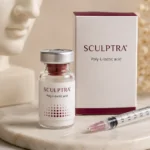
Collagen biostimulators take a different approach from conventional fillers. Instead of relying mainly on immediate gel volume, treatments such as Sculptra are designed to stimulate a gradual collagen response.
This makes them particularly relevant when the concern involves broader changes in skin support and tissue quality rather than one isolated wrinkle.
Results develop progressively, so collagen biostimulation is generally chosen by patients looking for gradual improvement rather than an immediate correction.
RF Microneedling and Morpheus8
Fine lines can also be associated with changes in skin texture, enlarged pores, acne scarring or reduced firmness.
In these cases, RF microneedling may be considered.
The treatment combines microneedles with radiofrequency energy delivered at controlled depths within the skin. The aim is to stimulate a healing and remodelling response rather than adding volume or reducing muscle movement.
Morpheus8 is one of the technologies used for fractional radiofrequency treatment and can be considered for selected facial and body concerns.
RF microneedling may be particularly relevant when a patient is concerned about a combination of:
- Fine lines
- Uneven texture
- Enlarged pores
- Acne scars
- Reduced skin firmness
Thermage FLX for Wrinkles and Skin Laxity
Wrinkles sometimes appear alongside a broader loss of skin firmness.
Thermage FLX uses monopolar radiofrequency energy to heat deeper layers of tissue while protecting the surface of the skin. It is primarily used to address skin laxity and stimulate collagen remodelling.
It may be considered when the concern involves mild-to-moderate looseness around areas such as the face, jawline or eye area rather than a single isolated expression line.
Thermage does not perform the same role as Botox or filler. It belongs to a different category of treatment and is generally selected when tissue firmness and skin laxity are part of the concern.
Ultherapy and Ulthera Prime
Ultherapy, including newer Ulthera Prime technology, uses focused ultrasound energy at selected tissue depths.
It may be considered when facial ageing includes skin laxity as well as lines, particularly around the lower face, jawline, under the chin and neck.
As with Thermage, Ultherapy is not designed to fill an individual wrinkle. Its role is more closely related to supporting tissue tightening and collagen remodelling.
Which Treatment Is Best for Your Wrinkles?
A forehead line that appears when you raise your eyebrows is not the same problem as a deep fold caused by facial volume loss. Fine lines around the eyes may also require a different approach from loose skin around the lower face and neck.
This is why treatment should start with the cause of the wrinkle.
For example:
- Expression lines → anti-wrinkle injections may be appropriate.
- Volume-related folds → dermal filler may be considered.
- Fine lines and dehydrated skin → skin boosters may be more relevant.
- Reduced collagen and tissue quality → collagen biostimulation may be considered.
- Fine lines with texture concerns → RF microneedling or Morpheus8 may be suitable.
- Wrinkles accompanied by skin laxity → Thermage FLX or Ultherapy may be considered.
Some patients have more than one of these concerns at the same time. In those cases, combining treatments may make more sense than trying to use one procedure to address everything.
Wrinkle Treatment by Area
Forehead Wrinkles
Forehead lines are often dynamic and become more visible when the eyebrows are raised.
Anti-wrinkle injections are commonly used when muscle movement is the main cause. If static lines remain visible at rest, skin quality and the depth of the lines should also be considered.
Frown Lines
Vertical lines between the eyebrows are often associated with repeated movement of the muscles used when frowning.
Anti-wrinkle injections are frequently considered for this area.
Crow’s Feet
Crow’s feet develop around the outer corners of the eyes and usually become more visible when smiling.
Dynamic crow’s feet may respond to anti-wrinkle injections, while fine lines related to skin quality may require a different or additional approach.
Wrinkles Around the Mouth
Lines around the mouth can have several causes, including repeated movement, collagen loss, changes in lip support and facial volume changes.
Because the mouth is a highly mobile area, treatment needs to preserve natural movement and expression.
Nasolabial Folds
- Nasolabial folds run from the sides of the nose towards the corners of the mouth.
- Although they are often called wrinkles, they are strongly influenced by facial structure and changes in mid-face volume.
- For this reason, simply filling the fold is not always the first or only option.
Neck Lines and Wrinkles
The neck can develop horizontal lines, fine wrinkles and skin laxity.
Depending on the underlying problem, treatment may involve injectable skin treatments, collagen-stimulating procedures or technologies such as RF microneedling, Thermage FLX or Ultherapy.
Can Wrinkle Treatments Be Combined?
Yes. Combination treatment is common because facial ageing does not happen in only one layer.
For example, one patient may have forehead lines caused by muscle movement, reduced cheek volume and early skin laxity at the same time.
Trying to correct all three concerns with filler — or all three with Botox — would not address the underlying causes appropriately.
A treatment plan may therefore combine different approaches, such as:
- Anti-wrinkle injections for expression lines
- Fillers for selected volume loss
- Skin boosters for hydration and fine lines
- Collagen biostimulators for tissue quality
- RF microneedling for texture
- Thermage FLX or Ultherapy for laxity
These treatments do not necessarily need to be performed during the same appointment. Timing depends on the procedures selected and the patient’s treatment plan.
At What Age Should You Start Wrinkle Treatment?
There is no specific age at which everyone should start aesthetic treatment.
Two people of the same age can have completely different skin quality, facial movement and ageing patterns.
Treatment should therefore be based on what is actually present rather than choosing a procedure simply because someone has reached their 30s, 40s or 50s.
Some younger adults seek treatment for strong dynamic expression lines, while an older patient may be more concerned about volume loss or skin laxity.
The treatment should match the concern, not the birthday.
How Long Do Wrinkle Treatment Results Last?
There is no single answer because “wrinkle treatment” includes several very different procedures.
Anti-wrinkle injections, dermal fillers, skin boosters, collagen biostimulators and energy-based treatments all work differently and have different treatment schedules.
Duration can also vary according to:
- Product or technology used
- Treatment area
- Dose or treatment protocol
- Facial movement
- Skin quality
- Metabolism
- Ageing
- Lifestyle
For this reason, fixed promises such as “wrinkles will disappear for 12 months” are not appropriate for a general wrinkle-treatment page.
Wrinkle Treatment in Istanbul
Istanbul has become a popular destination for international patients seeking both surgical and non-surgical aesthetic treatments.
For someone travelling specifically for wrinkle treatment in Istanbul, the treatment plan should take the length of stay into account.
Some procedures can be performed during a short visit and require relatively little downtime, while others may involve swelling, bruising or a treatment course spread across several sessions.
At Quartz Clinique, the consultation is used to assess:
- Type and depth of wrinkles
- Facial movement
- Skin quality
- Facial volume
- Degree of skin laxity
- Previous aesthetic treatments
- Suitable treatment options
- Recovery and follow-up requirements
International patients should mention their travel dates during treatment planning, particularly if several procedures are being considered.
How Much Does Wrinkle Treatment Cost in Istanbul?
The cost of wrinkle treatment in Istanbul depends on what is actually being treated and which method is appropriate.
There is no meaningful single price for “wrinkle treatment” because Botox, dermal fillers, skin boosters, Morpheus8, Thermage FLX and Ultherapy are completely different treatments.
Cost may vary according to:
- Treatment selected
- Number of treatment areas
- Product and amount used
- Device and treatment protocol
- Number of sessions
- Whether treatments are combined
A personalised assessment is therefore needed before an accurate treatment plan and cost can be provided.
Frequently Asked Questions About Wrinkle Treatment
What is the best treatment for facial wrinkles?
It depends on why the wrinkle has developed. Dynamic expression lines, volume-related folds, fine lines and wrinkles associated with loose skin may all require different treatments.
What is the best treatment for forehead wrinkles?
Forehead wrinkles are frequently related to muscle movement, which is why anti-wrinkle injections are commonly considered. Established static lines may require additional assessment of skin quality.
What treatment is best for crow’s feet?
Anti-wrinkle injections are commonly used for dynamic crow’s feet. Fine lines caused by changes in skin quality may benefit from additional skin-focused treatments.
Is Botox or filler better for wrinkles?
They have different purposes. Botox-type treatments reduce selected muscle activity, while fillers provide volume or structural support. One is not universally better than the other.
Can wrinkles be removed permanently?
No aesthetic treatment can permanently stop skin ageing. Treatments can soften particular wrinkles or improve skin quality, but ageing and facial movement continue over time.
Can I combine Botox with skin treatments?
Yes, selected injectable and device-based treatments can be combined within a treatment plan. They may be performed at different appointments depending on the procedures involved.
Can I have wrinkle treatment during a short trip to Istanbul?
Some treatments can fit into a short visit, but others require several sessions or follow-up. International patients should discuss their travel schedule before treatment is planned.
Will wrinkle treatment make my face look unnatural?
The result depends on the treatment selected, the amount used and how it is performed. The aim of a personalised plan is to address the underlying concern while preserving appropriate facial proportions and expression.
References
- Carruthers A, Carruthers J. Botulinum toxin in the treatment of glabellar frown lines and other facial wrinkles.
- Funt D, Pavicic T. Dermal fillers in aesthetics: an overview of adverse events and treatment approaches. Clinical, Cosmetic and Investigational Dermatology.
- Gold MH, et al. Fractional radiofrequency and microneedling technologies for facial rejuvenation and skin remodelling.
- Fabi SG, et al. Non-invasive skin tightening and collagen remodelling using radiofrequency and microfocused ultrasound technologies.
Content Responsibility and Medical Review

Medical expert
Medical Aesthetic Physician
Dr. Nur Afşar has been practicing in the field of medical aesthetics for over seven years. She has experience in a range of non-surgical aesthetic treatments, particularly Botox, dermal fillers, mesotherapy, and skin rejuvenation procedures. Her approach to treatment planning focuses on achieving natural and balanced results.
Medical content lead for Wrinkle Treatment: Dr. Nur Afşar
Last updated: