
DHI hair transplant is a hair restoration technique in which individual follicular units are implanted into the planned areas using a specialised implantation device, commonly known as a DHI or Choi implanter pen.
The technique gives the medical team direct control over the placement of each graft, including its direction, angle and distribution. For this reason, DHI may be considered for patients seeking restoration of the frontal hairline, temples or selected areas of thinning where detailed placement is important.
At Quartz Clinique in Istanbul, DHI hair transplant planning begins with an assessment of the donor area, existing hair, pattern of hair loss and the number of grafts that can be safely obtained. The technique is then selected according to the patient’s individual hair characteristics rather than using the same approach for every case.
What Is a DHI Hair Transplant?
DHI stands for Direct Hair Implantation.
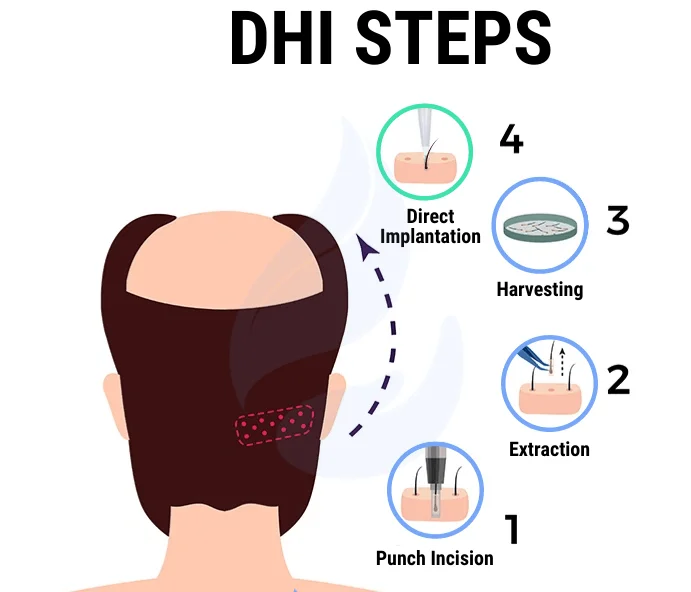
During a DHI procedure, healthy follicular units are individually extracted from the donor area, usually at the back and sides of the scalp. The collected grafts are prepared and then placed into the recipient area using an implanter device.
One of the defining features of DHI is therefore the implantation stage.
The implanter allows grafts to be positioned individually according to the planned direction and angle of the surrounding hair. This is particularly relevant around the frontal hairline, where small differences in placement can affect how the hairline looks once the transplanted hair has grown.
How Does the DHI Implanter Pen Work?
Each prepared follicular unit is carefully loaded into the implanter. The device is then used to place the graft into the planned position on the scalp.
The surgeon and hair transplant team can adjust factors such as:
- Implantation angle
- Direction of the graft
- Distribution between existing hairs
- Hairline design
- Graft density according to the available donor supply
The aim is not simply to implant as many grafts as possible. Donor capacity, existing hair density and the long-term pattern of hair loss all need to be considered when planning a DHI procedure.
Which Areas Can Be Treated with DHI?
DHI can be used for different patterns of hair loss depending on the patient’s donor area and diagnosis.
| Treatment Area | How DHI May Be Used |
|---|---|
| Frontal Hairline | Individual graft placement can be used to create the planned hairline shape and direction. |
| Temples | Fine graft placement may be used to restore selected areas of temporal recession. |
| Thinning Areas | Grafts may be positioned between existing hairs when the area is suitable for transplantation. |
| Crown | Placement can be planned according to the natural direction and whorl pattern of the crown. |
Who May Be Suitable for DHI Hair Transplant?
DHI may be considered for men and women with suitable donor hair who want to restore areas affected by hair loss or recession.
Suitability depends on more than the size of the thinning area. During assessment, factors such as donor density, hair calibre, scalp condition, existing hair and the progression of hair loss should also be considered.
Patients experiencing sudden, unexplained or active diffuse hair loss may require further evaluation before deciding whether hair transplantation is appropriate.
Does DHI Hair Transplant Require Shaving?
Not necessarily.
Depending on the number of grafts required, donor area and recipient area, DHI may sometimes be performed with partial shaving or limited shaving rather than shaving the entire scalp.
However, a completely unshaven procedure is not suitable for every patient. The decision should be based on the technical requirements of the transplant rather than appearance alone.
This can be particularly relevant for patients who want to return to their usual hairstyle with less visible change during the early recovery period.
Hairline Design with DHI
A successful-looking hair transplant depends on more than density.
The position of the hairline needs to suit the patient’s facial proportions, existing hair and likely future pattern of hair loss. The direction and angle of individual grafts also need to follow the surrounding hair.
Single-hair follicular units are commonly useful around the leading edge of the hairline, while grafts containing more hairs can be distributed further behind when appropriate.
The objective is to avoid an artificial-looking straight line and create a transition that fits the patient’s existing hair characteristics.
What Happens During a DHI Hair Transplant?
The procedure begins with hair and scalp assessment followed by planning of the recipient and donor areas.
Follicular units are individually extracted from the donor region. After preparation, the grafts are loaded into the implantation device and transferred to the planned areas.
The number of grafts required varies considerably between patients. A receding hairline, for example, does not require the same plan as more extensive thinning.
For general information about hair transplantation and donor-area planning, see our [Hair Transplant] page.
What Happens After DHI?
Small crusts and redness can develop around the implanted grafts during the early recovery period. Mild swelling may also occur in some patients.
Patients receive instructions on washing the scalp, sleeping position and protecting the transplanted area during the initial healing period.
The transplanted hairs may shed during the weeks following the procedure. This can be part of the normal hair transplant cycle and does not necessarily mean that the follicles have been lost.
When Does DHI Hair Transplant Start to Grow?
Hair transplantation is a gradual process.
After the initial shedding phase, new growth usually begins progressively over the following months. Early hairs may initially appear finer before becoming more established.
Changes continue as the transplanted follicles move through their normal growth cycles, so the appearance seen during the first few months should not be considered the final result.
Individual growth rates and outcomes vary.
Is DHI Hair Transplant Permanent?
Hair follicles used for transplantation are generally selected from donor areas that are more resistant to the typical pattern of androgenetic hair loss.
However, DHI does not stop future hair loss in the patient’s existing non-transplanted hair.
This is why long-term planning matters. The donor area is limited, and graft distribution should take possible future hair loss into account rather than concentrating only on the current thinning area.
DHI Hair Transplant in Istanbul, Turkey
Istanbul is a common destination for international patients considering hair transplantation.
For patients travelling from abroad, the initial consultation can include photographs of the front, temples, crown and donor area. These can help with preliminary planning, although the final graft assessment is performed in person.
At Quartz Clinique, international patients are informed about the procedure, early recovery and postoperative care before returning home.
DHI Hair Transplant Cost in Istanbul
The cost of a DHI hair transplant in Istanbul depends on the individual treatment plan rather than the name of the technique alone.
Factors that can influence the cost include:
- Number of grafts required
- Size and location of the treatment area
- Donor hair availability
- Complexity of hairline planning
- Extent of the procedure
- Individual treatment requirements
A personalised assessment is needed to estimate the appropriate graft plan and current treatment cost.
Frequently Asked Questions
What does DHI mean in hair transplant?
DHI stands for Direct Hair Implantation. It refers to an implantation approach in which prepared follicular units are placed into the recipient area using a specialised implanter device.
Is DHI different from FUE?
DHI primarily describes the way grafts are implanted. Individual follicular units may still be extracted using FUE principles. For this reason, the terms should not always be treated as completely separate procedures.
Is DHI suitable for the hairline?
DHI can be used for frontal hairline restoration when the patient’s donor hair and pattern of hair loss are suitable. Hairline design, graft selection, direction and angle are important parts of planning.
Can women have DHI hair transplant?
Yes. DHI may be considered for suitable female patients, particularly for selected areas of thinning, temple recession or hairline restoration. The cause of female hair loss should be assessed before transplantation.
Does DHI give a natural-looking result?
The appearance of a hair transplant depends on several factors, including hairline design, graft direction, donor quality, distribution and healing. The use of DHI alone cannot guarantee a particular result.
References
- International Society of Hair Restoration Surgery (ISHRS) — Patient information and terminology relating to hair restoration surgery.
- Peer-reviewed literature on follicular unit extraction and implantation techniques in hair transplantation.
- Peer-reviewed literature on hairline design, graft survival and donor-area management in hair restoration surgery.
Content Responsibility and Medical Review
Medical expert
Specialist in Plastic, Reconstructive and Aesthetic Surgery
Leyla Arvas graduated from Istanbul University, Istanbul Faculty of Medicine in 1998 and is a specialist in Plastic, Reconstructive and Aesthetic Surgery.
Dr. Leyla Arvas sees patients at her private practice and performs her surgeries at Acıbadem Hospital and Memorial Hospital, both of which are accredited by the Joint Commission International (JCI).
Medical content lead for DHI Hair Transplant: MD, Leyla Arvas, MD
Last updated: