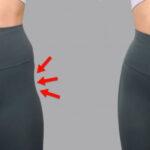
Hip dips are natural inward curves between the hips and upper thighs that are largely determined by pelvic anatomy, muscle structure and fat distribution. They are not a medical problem and do not require treatment. For people who prefer a smoother or rounder hip contour, however, hip dip correction can be considered using individually selected surgical or non-surgical approaches.
At Quartz Clinique in Istanbul, hip dips treatment is planned according to body proportions, available fat, tissue quality and the degree of contour change the patient would like to achieve.
What Are Hip Dips?
Hip dips are inward curves or indentations that appear along the outer sides of the hips, usually between the hip bone and upper thigh.
They are a normal anatomical feature rather than a deformity or medical condition.
The appearance of hip dips is influenced primarily by the relationship between the pelvis, femur, muscles and surrounding fat distribution. This is why hip dips can be noticeable even in people who exercise regularly or have a low body-fat percentage.
Some people naturally have very subtle hip dips, while others have deeper indentations.
Neither appearance is medically abnormal.
Hip Dips Treatment at a Glance
| Feature | Details |
|---|---|
| What Are Hip Dips? | Natural indentations between the hips and upper thighs |
| Main Causes | Pelvic anatomy, muscle structure and fat distribution |
| Do They Require Treatment? | No; treatment is entirely aesthetic |
| Correction Options | Fat transfer or selected non-surgical volume-enhancing treatments |
| Fat Transfer | Uses the patient's own fat harvested with liposuction |
| Non-Surgical Option | PLLA collagen biostimulation such as Lanluma may be considered in selected patients |
| Recovery | Depends on the treatment method and extent of liposuction |
| Treatment Plan | Individually determined according to anatomy and desired correction |
What Causes Hip Dips?
The most important factor behind hip dips is anatomy.
The shape and width of the pelvis and the relationship between the pelvis and femur influence the contour of the outer hip.
Other factors can affect how noticeable the indentation appears, including:
- Distribution of body fat
- Amount of fat around the outer hip
- Gluteal muscle structure
- Overall body composition
- Genetics
This explains why losing weight does not necessarily eliminate hip dips. In some people, lower body fat can actually make them appear more noticeable.
Similarly, gaining weight does not guarantee that fat will accumulate specifically within the hip dip area.
Can Exercise Get Rid of Hip Dips?
Exercise can strengthen and develop the muscles around the hips and buttocks, potentially changing the overall appearance of the area.
Exercises targeting the gluteal muscles may contribute to a stronger and more developed lower-body contour.
However, exercise cannot change the underlying shape of the pelvis or the position of the femur.
For this reason, exercise may soften the appearance of hip dips in some people but cannot guarantee their complete elimination.
This distinction is important because hip dips are often incorrectly presented as a problem caused by insufficient exercise.
Do Hip Dips Need to Be Corrected?
Hip dips are a normal variation in body shape and do not pose a health risk.
Treatment is considered only when an individual personally prefers a different hip contour.
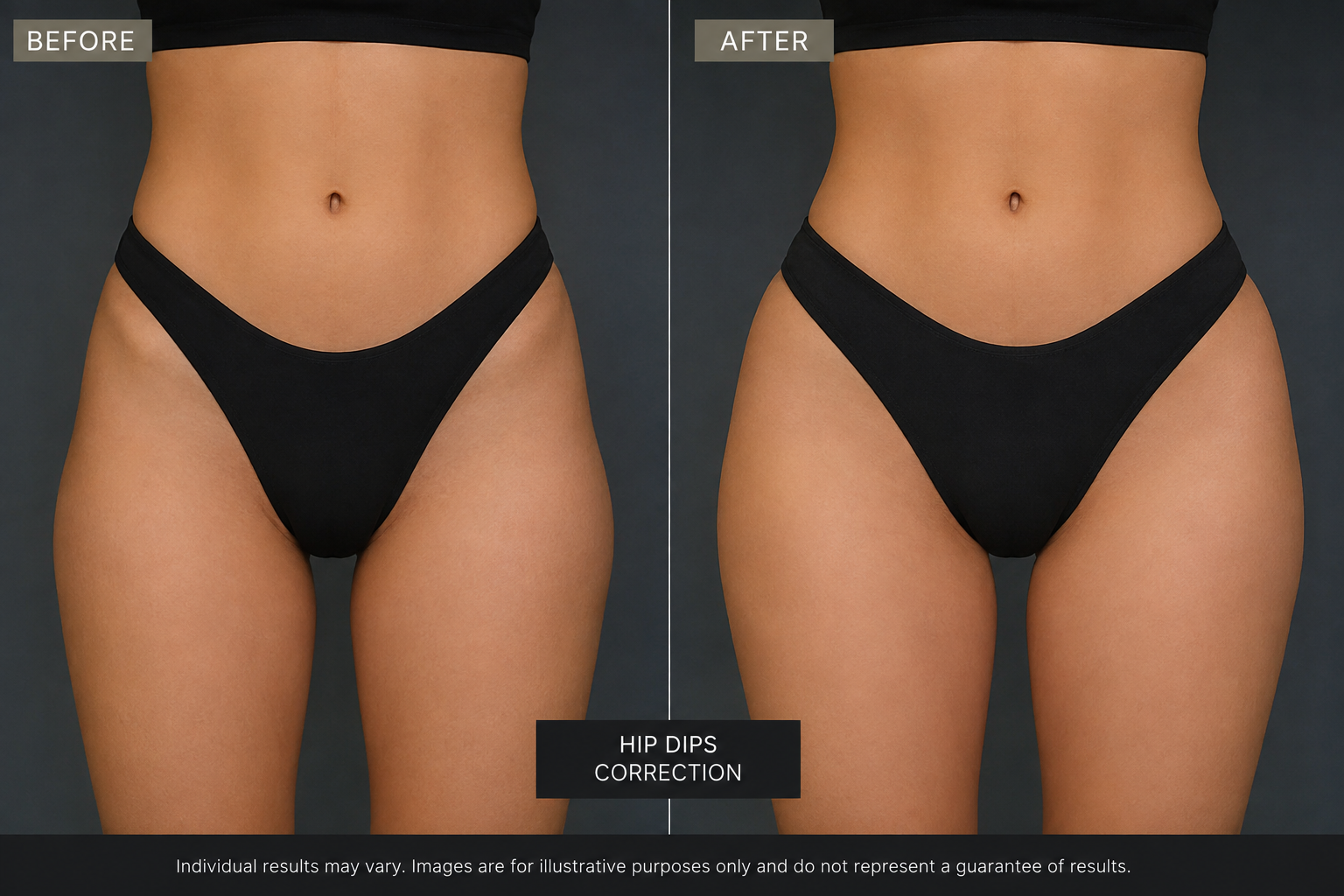
Patients seeking correction commonly want:
- A smoother waist-to-hip transition
- A rounder outer hip contour
- Greater symmetry between the hips
- A softer transition between the buttocks and thighs
- More balanced body proportions
The appropriate treatment depends on how much change is desired and the patient’s existing anatomy.
How Can Hip Dips Be Treated?
Hip dip correction is primarily based on adding volume to the indentation rather than changing the underlying bone structure.
Two approaches may be considered depending on the individual:
Fat transfer uses the patient’s own fat to add volume to the hip dip area.
PLLA collagen biostimulation, such as Lanluma, may provide a non-surgical alternative for selected patients seeking gradual volume improvement.
These treatments are fundamentally different and should not be considered interchangeable.
The most appropriate option depends on:
- Depth of the hip dips
- Desired amount of volume
- Availability of donor fat
- Overall body proportions
- Whether additional body contouring is desired
- Willingness to undergo liposuction and surgery
- Preference for surgical or non-surgical treatment
Hip Dip Fat Transfer
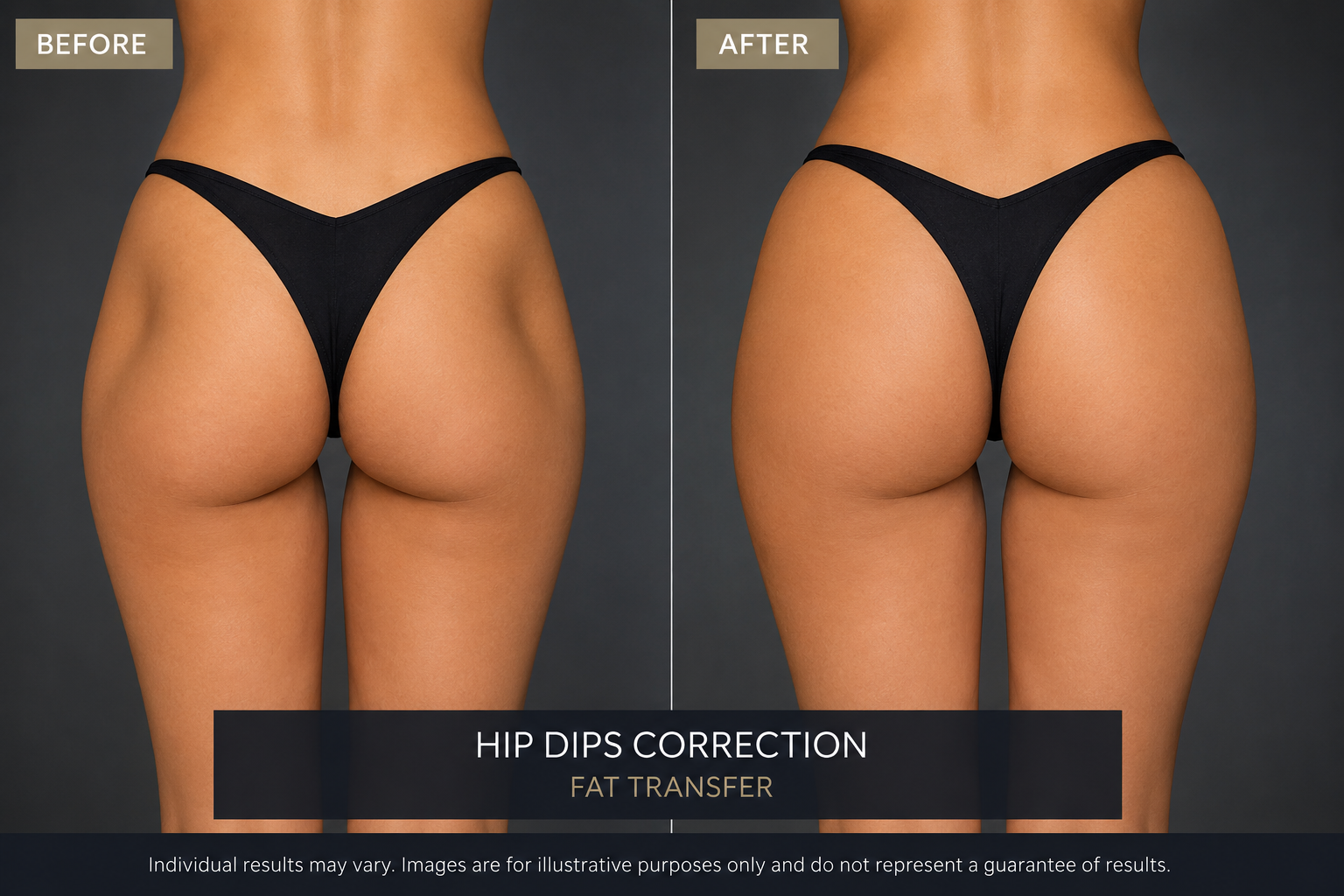
Fat transfer is one of the principal surgical approaches for correcting hip dips.
The procedure uses the patient’s own fat to add volume to the indentations and create a smoother transition between the waist, hips and thighs.
Fat is first harvested from selected areas of the body using liposuction.
Common donor areas may include:
- Abdomen
- Waist
- Flanks
- Thighs
The harvested fat is then processed and prepared before being carefully transferred into selected areas around the hips.
The procedure can therefore address two aspects of body contour simultaneously: reducing unwanted fat in selected donor areas and adding volume where required.
How Is Hip Dip Fat Transfer Performed?
Treatment begins with an assessment of the entire waist, hip and buttock contour rather than evaluating the indentation alone.
This is important because hip dips form part of the overall relationship between the waist, pelvis, buttocks and thighs.
The procedure generally involves three main stages:
1. Fat Harvesting
Fat is removed from selected donor areas using liposuction.
The location and amount of fat removed are determined according to the patient’s body proportions and the amount required for transfer.
2. Fat Preparation
The harvested tissue is processed so that suitable fat can be prepared for transfer.
3. Fat Transfer
The prepared fat is carefully placed into selected areas to soften the indentation and improve the outer hip contour.
The volume and distribution of transferred fat are planned according to anatomy rather than attempting to create the same hip shape in every patient.
Hip Dip Correction with VASER Liposuction and Fat Transfer
In selected patients, hip dip correction can form part of a broader body contouring procedure.
VASER-assisted liposuction may be used to remove unwanted fat from areas such as the abdomen, waist or flanks. Suitable harvested fat can then be processed and transferred according to the surgical plan.
This approach can be particularly relevant when the objective is not simply to fill the hip dips but to improve the overall waist-to-hip contour.
For example, reducing excess fat around the waist while adding selected volume to the outer hips can influence the overall silhouette differently from treating the indentation alone.
However, the suitability of VASER liposuction and the amount of fat available for transfer must be determined individually.
Lanluma for Hip Dips
For selected patients who do not want fat harvesting or do not have sufficient donor fat, a non-surgical approach using a PLLA collagen biostimulator may be considered.
Lanluma contains poly-L-lactic acid (PLLA).
Rather than providing the same type of direct volume as transferred fat, PLLA stimulates collagen production within the treated tissue. The resulting volume and contour improvement develops progressively.
Lanluma may be considered for patients seeking:
- Gradual hip dip improvement
- A non-surgical approach
- More subtle volume enhancement
- No liposuction or donor-fat harvesting
The degree of correction achievable with Lanluma differs from surgical fat transfer. Patients seeking substantial changes in hip width or buttock volume may require a different treatment strategy.
Hip Dip Fat Transfer vs Lanluma
The choice between fat transfer and Lanluma depends primarily on anatomy and the degree of correction desired.
| Feature | Fat Transfer | Lanluma |
|---|---|---|
| Material | Patient's own fat | Poly-L-lactic acid (PLLA) |
| Approach | Surgical fat harvesting and transfer | Non-surgical injectable treatment |
| Liposuction Required | Yes | No |
| Volume Development | Initial volume is visible after treatment, although swelling and fat retention affect the final result | Volume improvement develops progressively through collagen stimulation |
| Donor Fat Required | Yes | No |
| Body Contouring | Liposuction can simultaneously reshape selected donor areas | Does not remove fat from other areas |
| Recovery | Longer because liposuction and fat transfer are involved | Generally more limited than surgical fat transfer |
Neither treatment is universally better.
Fat transfer may be more appropriate when a larger degree of contour change is desired and sufficient donor fat is available.
Lanluma may be considered when the patient prefers a non-surgical approach and accepts more gradual, generally subtler volume improvement.
Hip Dips and BBL: What Is the Difference?
Hip dip correction and a Brazilian Butt Lift (BBL) are related body contouring concepts but are not necessarily the same procedure.
Hip dip fat transfer specifically focuses on improving indentations along the outer hips.
A BBL generally involves a broader surgical approach to buttock and body contouring using liposuction and fat transfer.
Depending on anatomy and treatment goals, a surgical body contouring plan may address:
- Waist definition
- Flanks
- Hip dips
- Buttock shape
- Buttock volume
- Overall waist-to-hip proportions
For some patients, isolated hip dip correction is sufficient. For others, treating the hips without considering the surrounding waist and buttock contour may not achieve the desired proportion.
The surgical plan should therefore be based on the entire body contour rather than a single indentation.
Who Is a Good Candidate for Hip Dip Fat Transfer?
Fat transfer may be considered for adults who are bothered by the appearance of their hip dips and have sufficient donor fat available for harvesting.
Potential candidates may include people who:
- Want a smoother outer hip contour
- Have sufficient fat in suitable donor areas
- Want more significant volume correction
- Would also benefit from liposuction of selected areas
- Have realistic expectations regarding fat survival and body shape
- Are medically suitable for surgery
Very lean patients may not have sufficient donor fat for the desired degree of correction.
In these situations, a non-surgical option or a different treatment strategy may be considered.
How Much Fat Is Needed for Hip Dip Correction?
There is no standard amount of fat that should be transferred to every patient.
The required volume depends on:
- Depth and size of the hip dips
- Difference between the two sides
- Existing hip and buttock proportions
- Amount of donor fat available
- Desired degree of correction
- Quality of the harvested fat
- Overall surgical plan
The amount initially transferred is also not identical to the amount that will ultimately remain.
Some transferred fat may be reabsorbed during healing, which is why the final result should be assessed after the tissues have stabilised.
Are Hip Dip Fat Transfer Results Permanent?
Fat transfer can provide long-lasting volume, but it should not be described as completely predictable or permanently unchanged.
After transfer, some of the fat does not survive and is gradually reabsorbed by the body.
The fat cells that successfully establish a blood supply can remain as living tissue.
Long-term contour can nevertheless change with:
- Weight gain
- Weight loss
- Ageing
- Pregnancy
- Changes in body composition
The final result is therefore influenced both by fat survival and future changes in the patient’s body.
When Can Hip Dip Results Be Seen?
An initial contour change can be visible immediately after fat transfer, but this is not the final result.
Swelling is expected after both liposuction and fat transfer.
During the following weeks and months:
- Swelling gradually decreases
- Some transferred fat may be reabsorbed
- Remaining fat begins to stabilise
- The body contour becomes easier to evaluate
For this reason, early postoperative appearance should not be used to judge the final amount of retained volume.
Lanluma follows a different timeline because its intended contour improvement develops gradually through collagen stimulation.
Hip Dip Fat Transfer Recovery
Recovery depends on the extent of liposuction, amount of fat transferred and whether additional body contouring procedures are performed.
During the early recovery period, patients may experience:
- Swelling
- Bruising
- Tenderness
- Tightness in liposuction areas
- Temporary changes in sensation
Compression garments may be recommended for liposuction areas according to the surgical plan.
Patients are generally advised to avoid unnecessary pressure on areas where fat has been transferred.
The timing of returning to work, exercise and unrestricted activity varies between individuals and should be determined according to postoperative progress.
International patients should take the recovery period into consideration when planning their stay in Istanbul.
Risks of Hip Dip Fat Transfer
Hip dip fat transfer is a surgical procedure and carries potential risks associated with both liposuction and fat grafting.
These can include:
- Bleeding
- Infection
- Fluid accumulation
- Contour irregularity
- Asymmetry
- Changes in sensation
- Fat resorption
- Under-correction or over-correction
- Need for additional treatment
Fat grafting around the gluteal region also requires particular attention to surgical anatomy and injection technique because serious complications have been associated with unsafe gluteal fat injection practices.
Patient selection, surgical planning and appropriate technique are therefore important safety considerations.
Hip Dips Treatment in Istanbul
Istanbul is a major destination for international patients considering cosmetic surgery and body contouring procedures.
For patients travelling for hip dips treatment in Istanbul, treatment planning should evaluate the entire body contour rather than simply deciding how much volume to place into the indentation.
At Quartz Clinique, assessment may include:
- Waist-to-hip proportions
- Depth and symmetry of hip dips
- Buttock shape
- Distribution of body fat
- Available donor fat
- Skin and tissue quality
- Desired degree of correction
- Whether fat transfer or a non-surgical approach is more appropriate
For patients undergoing fat transfer, the travel plan should also account for liposuction recovery and postoperative follow-up.
Patients considering Lanluma should take into account that collagen-stimulating treatments may require a different session schedule and that results develop progressively.
Hip Dips Treatment Cost in Istanbul
The cost of hip dip correction in Istanbul depends primarily on the treatment method and individual treatment plan.
For fat transfer, factors influencing cost may include:
- Number and size of liposuction areas
- Amount of fat required
- Complexity of body contouring
- Operating room and anaesthesia requirements
- Whether other areas are treated during the same procedure
For Lanluma, cost depends more heavily on the amount of product required, size of the treatment area and number of sessions.
For this reason, comparing hip dip treatment prices without knowing the proposed technique and extent of treatment can be misleading.
An individual assessment is required to determine the appropriate treatment plan and associated cost.
Frequently Asked Questions About Hip Dips
Are hip dips normal?
Yes. Hip dips are a normal anatomical variation created by the relationship between the pelvis, femur, muscles and surrounding fat. They are not a disease or deformity.
Can you completely get rid of hip dips?
The appearance of hip dips can be reduced by adding volume to the area, but treatment does not change the underlying bone structure. The achievable degree of correction depends on individual anatomy.
Can losing weight remove hip dips?
Not necessarily. Because hip dips are strongly influenced by skeletal anatomy and fat distribution, losing weight does not guarantee improvement and can make the indentation more noticeable in some people.
Can you fill hip dips with your own fat?
Yes. Fat can be harvested from suitable donor areas using liposuction, processed and transferred to selected areas around the hips in appropriate surgical candidates.
Is hip dip fat transfer the same as a BBL?
Not exactly. Hip dip fat transfer specifically targets the outer hip indentations, whereas BBL surgery generally involves broader buttock and body contouring. Hip dip correction can form part of a BBL treatment plan.
Which is better for hip dips, fat transfer or Lanluma?
Neither is universally better. Fat transfer may allow greater contour change when sufficient donor fat is available but involves surgery and liposuction. Lanluma is non-surgical and does not require donor fat, but its effect develops gradually and the degree of volume enhancement is different.
Can skinny patients have hip dip fat transfer?
It depends on whether sufficient donor fat is available. Very lean patients may not have enough suitable fat to achieve the desired correction. Alternative treatment options can then be discussed.
Does transferred fat disappear?
Some transferred fat is expected to be reabsorbed during healing. The fat that successfully establishes a blood supply can remain long term, although future weight changes and ageing can alter the contour.
How long should I stay in Istanbul after hip dip fat transfer?
The appropriate length of stay depends on the extent of liposuction, fat transfer and individual recovery. International patients should allow time for early postoperative monitoring and should confirm their travel schedule with the surgical team before booking return flights.
Can hip dips come back after treatment?
The underlying anatomy remains unchanged. Long-term appearance can also change with fat resorption, weight fluctuations, ageing and other changes in body composition. Additional treatment may therefore be considered in selected cases.
References
- Published clinical literature on autologous fat grafting and long-term outcomes in gluteal contouring.
- Published safety literature and professional recommendations concerning gluteal fat grafting techniques and complications.
- Clinical literature regarding poly-L-lactic acid (PLLA) for minimally invasive gluteal augmentation and body aesthetic applications.
Content Responsibility and Medical Review

Medical expert
Specialist in Plastic, Reconstructive and Aesthetic Surgery
Leyla Arvas graduated from Istanbul University, Istanbul Faculty of Medicine in 1998 and is a specialist in Plastic, Reconstructive and Aesthetic Surgery.
Dr. Leyla Arvas sees patients at her private practice and performs her surgeries at Acıbadem Hospital and Memorial Hospital, both of which are accredited by the Joint Commission International (JCI).
Medical content lead for Hip Dips: MD, Leyla Arvas, MD
Last updated: